so i totally yelled at elliot on Saturday. I mean, not really--it's not like I lost my temper or was actually angry, really, at all. But he was bouncing on Ada's head--by which I mean, literally sitting on her head and bouncing up and down and I just decided that this behavior could not continue. I am tolerant; Ada is tolerant. But head bouncing is right out. Forever. Definitely. Finito.
So anyway, I was like, "Elliot, NOOO. Noooooo." Very firmly and loudly; there may have been some finger wagging and meaningful eye contact. Elliot's response was to burst out laughing, so I was like--oh well, so much for my attempt at being Firm.
But it's interesting, because although Elliot has not ceased in his attempts to bounce on Ada he's become very interested in the word "no." All day yesterday, sometimes in context and somtimes not, he just wandered around bellowing "noooo, nooo, noooooooooooo."
Brandon says he is doing a very good imitation of me, which is to say, I think, that Elliot's attempting to convey a complex series of ideas: "it's not that I am angry but rather I'm just disappointed that you are failing to live up to the moral standards which you and I both, I'm sure, agree are imperative for the sustainability of social order, but as I said, I'm certainly not mad."
April 21, 2008


April 20, 2008
Today's Reading
I highly highly recommend this essay, in today's Times. It's about an important question, maybe the most important question: why should we bother? When there is a big problem, a problem which needs to be solved but is bigger than our our ability to solve it, what should we do? When our actions cannot "solve" the problem, why should we change them?
The specific set of problems this essay is about are environmental, but they are more generally social; they are about taking responsibility for our own lives. This is something I have been thinking about lot lately--I am struggling with the fact that despite my commitment to living ethicically and responsibly I do not think about ethics or responsibility as I go about making most of my daily decisions, particularly my consumer decisions. I am trying to change that.
For me, this is closely tied with the experience of becoming a parent, because parenting has made me think very vividly about my ideas about consuming, conserving, and prioritizing. More specifically, I've been thinking about how often I think about parenting in terms of consuming rather than preserving and prioritizing--which is too bad.
Anyway, I'm veering precipitously away from my main point here, which is also the main point of the essay, which I will link to again, because I really think it's just that good. The main point is--you should bother. You should try.
For instance, consider this:
and this:
And finally, this:
Lest I sound hackneyed and kneejerky and pedantic-- I don't mean to. I don't mean that you should make superficial changes that don't make a difference--there are so many of these. I just mean that I am trying to be open to, and less cynical about, the idea of radical personal change and the ways that it can, maybe, matter.
*here i would add that we need to think carefully about how to put pressure on the corporations which accomodate our desires--it doesn't do much to cut down on your own water use, for example, without encouraging government to change legislation for corporate water waste and pollution, which is (from what I've read) a much bigger problem.
For instance, consider this:
It’s hard to argue with Michael Specter...when he says: “Personal choices, no matter how virtuous [N.B.!], cannot do enough. It will also take laws and money.” So it will. Yet it is no less accurate or hardheaded to say that laws and money cannot do enough, either; that it will also take profound changes in the way we live. Why? Because the climate-change crisis is at its very bottom a crisis of lifestyle....For us to wait for legislation or technology to solve the problem of how we’re living our lives suggests we’re not really serious about changing — something our politicians cannot fail to notice. They will not move until we do. Indeed, to look to leaders and experts, to laws and money and grand schemes, to save us from our predicament represents precisely the sort of thinking — passive, delegated, dependent for solutions on specialists — that helped get us into this mess in the first place.
and this:
Cheap energy, which gives us climate change, fosters precisely the mentality that makes dealing with climate change in our own lives seem impossibly difficult. Specialists ourselves, we can no longer imagine anyone but an expert, or anything but a new technology or law, solving our problems...which is probably why we prefer to cross our fingers and talk about the promise of ethanol and nuclear power — new liquids and electrons to power the same old cars and houses and lives.
And finally, this:
...our relationship to the planet need not be zero-sum...as long as the sun still shines and people still can plan and plant, think and do, we can, if we bother to try, find ways to provide for ourselves without diminishing the world.
Lest I sound hackneyed and kneejerky and pedantic-- I don't mean to. I don't mean that you should make superficial changes that don't make a difference--there are so many of these. I just mean that I am trying to be open to, and less cynical about, the idea of radical personal change and the ways that it can, maybe, matter.
*here i would add that we need to think carefully about how to put pressure on the corporations which accomodate our desires--it doesn't do much to cut down on your own water use, for example, without encouraging government to change legislation for corporate water waste and pollution, which is (from what I've read) a much bigger problem.
April 16, 2008
Today
Someone in our house did the following today:
- Closed the dog in this special between-the-doors place, unbeknownst to everyone else. She was not discovered for an hour.
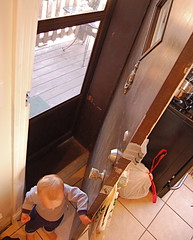
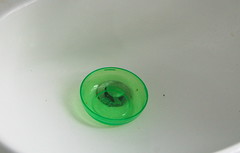
- Took a shit in this bowl, which happened to be lying on the floor:
- Awakened the entire household at 5:30 AM. It felt like this:

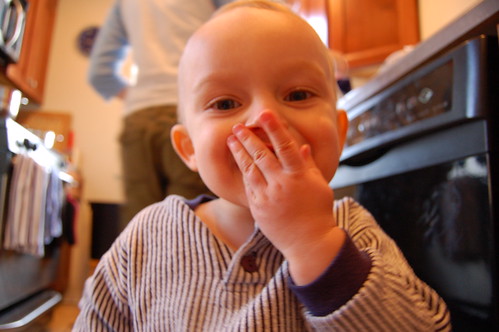
- The culprit was last seen avidly blowing kisses just like this one:

April 15, 2008
Everyday Use
So, this morning while working away while at our lovely local coffee shop I up and dropped my WHOLE CUP OF COFFEE onto my laptop. The whole thing, onto the keys, drip drip drip, and out through the battery slot on the back.
Now, as you join in the collective gasp of horror issued at that moment by every coffee shop witness, including some meddlesome geek who asked the barrista if she "had a blowdryer" to dry out the computer (what, in her purse?) as well as Brandon and the crazy scone lady, let me assure you that probably probably probably this is fine, the computer is fine, plus it's totally under warranty, and plus I have a print out of my most recent chapter draft, and plus, here I am, typing on another household computer. It's fine.
Still, though. I mean, my laptop. My laptop. I might as well say, my life's work.
I had to go sit in a comfy chair in the corner and fiddle and be all like my laptop, my laptop (here I think of Shylock, having royally fucked up, my ducats, my daughter) and really hang out there with the fact that really, I couldn't blame that spilled coffee on anyone else, and probably not even on Elliot who wasn't there, and probably not on being sort of tired from giving blood yesterday, and probably it was just my fault.
Which is the sort of thing I have to be really meditative about, because like most people I have the tendency to have a gut reaction of being crabby and angry when I've done something careless or wrong, and then take that out on other people who might point out (not that anyone did, as it was obvious) that it was my fault, because then they are picking on me when I feel bad and I might have been careless but they are being MEAN, which is WORSE.
This is such a disturbing part of the human personality--to emotionally compensate for our failures by bringing others down with us. [edited to add--i'm just reading through this and noticing another means of emotional compensation to which I am prone, which is me being all "well, I might be careless but at least I am wise," which is great, but it doesn't dry out your laptop.]
Anyway. I sat there in my chair and thought about Elliot, and how he will break things and spill things, and I will have to teach him to not be careless, but also be nice to him, because being careless or just not careful enough with something special feels so bad. But mostly I thought about how the hard thing about being a grown up is that you have to allot your own portion of guilt, and sit with it, and then also forgive yourself when your penance is done, and no one but you can decide when that is, when it's okay to pat yourself on the back and say, it's okay, you didn't mean to, you'll do better next time.
April 12, 2008
Radio Flyer Sample Sale: A Disagreement over fundamental values

Why was he obsessed with it? Because he could clearly tell that it was the shiniest thing around, and that it was big, way too big. Completely unwieldy for a person of his size. But big and shiny are concepts he gets, and cares deeply about. He wept angrily when we plopped him on the toys that were actually his own size. He would have none of it.
We selfish adults bought him -- what? A wee, tiny red wagon, about twelve inches long, for ten dollars. It is the cutest little wagon, perfect for dolls, animals, blocks, and other small friends. It's the kind of wagon you can take under the dining room table with you, or wear as a hat.
Does Elliot care about this wee wagon? Not really.
April 06, 2008
where I want to read my book
I just saw this!

One of the pleasingest weeks of my earlier life was this one winter when we moved, right at the end of the semester. My new school and new semester didn't start quite yet, so I had a whole winter week to spend doing nothing--nothing but sit in the attic eaves of our new house and eat english muffins with cheese and drink grape juice and read read read. The ceiling slanted down close, but there was a window, and I dragged in all these pillows and it was so snug and airy and fantastic.
Brandon and I often discuss the logistics of making a reading nook for Elliot. Since it's not looking like we'll have some odd attic crawl space anytime soon, maybe we'll build something like this. When, as the website says, we move to a loft and then we, both of us, marry a carpenter.

April 01, 2008
Elliot soulful; me sweaty
 Elliot here being the particular kind of darling that merits the "vignette" and "blur edges" effects in iphoto (the other advantage of those effects being that they deemphasize my just-back-from-run sweatiness).
This is mostly just to say that elliot is very sweet in this overall action, and that all day he kept reminding me of Almanzo from Farmer Boy.
However, since Amy asked, here is an article about the children/soy issue. From what I can tell at a preliminary review of the topic, here are the things worth noticing.
- We have the idea that soy is "healthy" and "natural." While it may well be perfectly healthy, in most of the forms that American consumers encounter soy, it is incredibly processed, and no more "natural" than your average chemical additive.
- Also, there are major agribusiness interests involved in marketing soy to us, in convincing us that soy is (as above) healthy and natural, and in getting producers to use soy all over the place.
- There are some concerns about the health of soy. It seems that it has some "anti-nutrients" which in large quantites can hurt the body's ability to process calcium and protein, and some feel there haven't been adequate studies done to determine what should be considered harmful.
- There is also some evidence that soy, again in some undetermined quality, has detrimental hormonal effects, leading to weird thyroid functioning and, more disturbingly, weird reproductive/fertility function, even later in life.
If people have thoughts on it beyond that, I'd be interested to know. It seems to be in one of those grey areas where you have to think about where your burden of proof is: is it more important to you that a food be "proven" healthy, or that it be "proven" unhealthy?
We eat soy, but not much, since mostly we eat tasty tasty meat. But it occurs to me that I have clearly been absorbing the "soy=good" logic. The few times we had to buy formula I remember thinking that maybe I should get the "healthy fancy good" soy kind--I had some sense that choosing soy was choosing better. Which maybe it is, but it's also just choosing a successful marketing pitch.
Here, Elliot as skeptic; a familiar family role:

Sigh, more reasons to be careful about your consuming
I don't really approve of tear-jerky things like this--I mean, is it like it would be okay to kill species if they weren't sweet and cute and songbirdy? Like, we can use all the pesticides we want as long as the only victims are toads and cockroaches? Either it's ethical or it's not, people. C'mon.
Still, here's today's article about how to shop so that your shopping doesn't "kill a songbird."
I mean, really. Do we need to get all Harper Lee on the environment? Apparently so.
The main facts I take from it:
1)As you think about where to shop, remember that many developing countries don't have rigorous limits on chemical use. So if you buy things from those countries, you and the birds will be healthier if you buy those goods fair trade (family farmers usually use more traditional, earth-friendly methods).
2)Bananas are one of the highest pesticide requiring foods, according to this. So while the thick peel might protect you, and thus keep bananas off most "top foods to buy organic" lists, they have a high environmental cost.
Still, here's today's article about how to shop so that your shopping doesn't "kill a songbird."
I mean, really. Do we need to get all Harper Lee on the environment? Apparently so.
The main facts I take from it:
1)As you think about where to shop, remember that many developing countries don't have rigorous limits on chemical use. So if you buy things from those countries, you and the birds will be healthier if you buy those goods fair trade (family farmers usually use more traditional, earth-friendly methods).
2)Bananas are one of the highest pesticide requiring foods, according to this. So while the thick peel might protect you, and thus keep bananas off most "top foods to buy organic" lists, they have a high environmental cost.
March 31, 2008
Beck Being Smart: or, more on dressing daughters
I keep writing these quick little posts on all these complicated issues. O, how their incompletion irks me. Brevity is the soul of blog posts, but it's super irritating.
Anyway, from Beck today:
Which I think is a great summary of how we teach boys to be agents and girls to be objects, and how very sad it is.
I will add to Beck's articulation, however, that it is not only what she calls the "pre-teen tartwear" that objectifies our daughters. I think a lot of very conservative "girly" clothes do the same thing. Is it doing more of a deservice to daughters when we dress them in tartwear than when we dress them in frilly, facile clothes that impede their movement, require their cleanliness, and locate their value in their "innocence" of everything--action, sexuality, anger, outspokenness, intensity--that is equated with being powerful in the world? What to think of the white antique linen dresses hanging in my closet, waiting to dress the daughters I don't even have? How much worse for girls are bratz than barbies, anyway?
Which is all to say that sexualization is stylistically intertwined with but not fully reducible to the larger question of the ways little girls' appearance matters in the world, and the different ways it matters than the appearances of little boys.
And in both areas--objectification in general, and sexual objectification in particular--we raise the question of the degree to which being an object can actually be interesting or, in a weird way, powerful. I suspect every woman who reads this has had some experiences in which their appearance, and the sense of being looked at or desired, made them feel powerful, and some in which being reduced to your appearance was incredibly incredibly frustrating and even demeaning.
As a feminist and a woman and a mother, I have lots of thoughts about this. But let me for the moment answer my own question, above, with a pragmatic and unfortunate: yes. Yes, sexualized objectification is, in some ways, more dangerous. I'm rather sad to say it. But girls get pregnant, and are more at risk of a whole series of diseases, and are more liable to be punished socially for their sexuality, and more likely to be physically endangered by their sexuality.
It's like children's wear learned the wrong lesson from the sexual revolution. It's unfair to expect girls or women to be sexual in the way that men are, not only for whatever biological reasons you think exist, but because sexuality, for women, is still profoundly unsafe. Until that changes, sexualizing young girls is not just tasteless or crude or morally questionable. It's physically dangerous as well.
Anyway, from Beck today:
I will do things, The Boy's clothing predicts, possibly unwise things but whatever - an exciting future awaits, needing sturdy pants and cars that go places, skateboards that will hurtle through the air. The future that we offer our daughters promises less, a cheap disposable sexuality and a world where there are no adults. Look at me.
Which I think is a great summary of how we teach boys to be agents and girls to be objects, and how very sad it is.
I will add to Beck's articulation, however, that it is not only what she calls the "pre-teen tartwear" that objectifies our daughters. I think a lot of very conservative "girly" clothes do the same thing. Is it doing more of a deservice to daughters when we dress them in tartwear than when we dress them in frilly, facile clothes that impede their movement, require their cleanliness, and locate their value in their "innocence" of everything--action, sexuality, anger, outspokenness, intensity--that is equated with being powerful in the world? What to think of the white antique linen dresses hanging in my closet, waiting to dress the daughters I don't even have? How much worse for girls are bratz than barbies, anyway?
Which is all to say that sexualization is stylistically intertwined with but not fully reducible to the larger question of the ways little girls' appearance matters in the world, and the different ways it matters than the appearances of little boys.
And in both areas--objectification in general, and sexual objectification in particular--we raise the question of the degree to which being an object can actually be interesting or, in a weird way, powerful. I suspect every woman who reads this has had some experiences in which their appearance, and the sense of being looked at or desired, made them feel powerful, and some in which being reduced to your appearance was incredibly incredibly frustrating and even demeaning.
As a feminist and a woman and a mother, I have lots of thoughts about this. But let me for the moment answer my own question, above, with a pragmatic and unfortunate: yes. Yes, sexualized objectification is, in some ways, more dangerous. I'm rather sad to say it. But girls get pregnant, and are more at risk of a whole series of diseases, and are more liable to be punished socially for their sexuality, and more likely to be physically endangered by their sexuality.
It's like children's wear learned the wrong lesson from the sexual revolution. It's unfair to expect girls or women to be sexual in the way that men are, not only for whatever biological reasons you think exist, but because sexuality, for women, is still profoundly unsafe. Until that changes, sexualizing young girls is not just tasteless or crude or morally questionable. It's physically dangerous as well.
Food Success

Anyway, we're super excited that Elliot has added a big number seven to his list of acceptable foods. It is a kind of exciting and moral new food--Brandon's homemade protein bars, inspired by Alton Brown's "Good Eats" recipe. They include things like tofu,** wheat germ, eggs, peanut butter, and protein powder, and I can confirm that they are quite good. I mean, sure, they are protein bars, which means that they're weird. But weird is relative when you're feeding a child.
That photo has nothing to do with food or protein bars. It's just cute.
*I should say that Elliot's eating has gotten better in the last couple of weeks; we're back to eating some staples. Peas, for instance, have returned into favor.
**Do people have thoughts on the soy protein for children issue? I know a couple of people who are convinced that it's a terrible idea, but I myself haven't found any proof that I would consider conclusive on that issue.
March 27, 2008
Kids Swearing
So NPR did this completely underdeveloped story on dealing with your kids' swearing. It's friendly and all, but I don't think it gets us very far. I agree with the point one of their interviewees makes that I am less worried about my child swearing than I am about my child being mean. Okay, then. But does that mean I should stop swearing?
I am a little up in the air on this one, as Michelle and Rox and I were just talking about. So I'm just putting it out there. I feel like this is one of many parenting issues that people respond to in a gut way, without really thinking through the underlying issues. And that's fine, because who has the time to really develop a full-fledged theory of your child's speech acts? Much easier to just stop swearing.
Except I sort of like swearing. It's a part of adult life, unlike going to shows or staying out late dancing or having one too many beers, that I did not necessarily have to give up when I became a parent. And not only is it a marker of my adulthood in general, my language is a marker of the particular mode of adulthood I have chosen: a little irreverent, a little outside of bourgeois norms, a little funny, a little bit free of a some ideas of tidy, euphemistic, womanhood. I'm not the kind of woman who drinks wine coolers and watches her tongue. I drink beer, and I swear. I am not a delicate flower.
I mention this because I think something we might talk about more often is how our children's swearing reflects upon us as parents, and mothers in particular. When our children swear, it's not so much that adults judge them, it's that they judge us. As a wise women I know once said: "when kids swear, people think their mother's don't love them." I think that's sort of sadly true, because mother's are the ones we still expect to teach our children moral propriety.
Swearing has this sort of metonymic significance: if you reject proper language, maybe you also reject other socially appropriate behaviors! Like, if you don't teach your child not to swear, you might also not teach your child to be clean, or not to litter, or to go to school on time, or not to be unkind, or not to be lazy, or to keep their promises or live in a principled way at all. And if you don't teach your child those things, well, you are clearly a bad mom.
Now, of course, one of the reasons why I find bourgeois norms irritating is that I would like to break the association between trivial things like swearing and important things like living a principled life. But here's the deal: bourgeois norms might be outdated and irritating. But they are still powerful.
So I think if we don't teach our children how to behave in polite and tidy bourgeois society, it's still a sign that we aren't giving our child access to the power of that world. And it's one thing for them to opt out on their own. It's another for us not to teach them how to behave there.
And, quite frankly, even if I do often swear or speak irreverently, there are times when I don't want that part of my personality on display. I don't think swearing is very taboo, but my grandmother thinks it is--so I don't swear around her, because in her mind it would move form being "irreverent" to being "sinful," which is completely different. And I can't expect my child to respect my boundaries if I haven't taught them that those boundaries are important.
I am a little up in the air on this one, as Michelle and Rox and I were just talking about. So I'm just putting it out there. I feel like this is one of many parenting issues that people respond to in a gut way, without really thinking through the underlying issues. And that's fine, because who has the time to really develop a full-fledged theory of your child's speech acts? Much easier to just stop swearing.
Except I sort of like swearing. It's a part of adult life, unlike going to shows or staying out late dancing or having one too many beers, that I did not necessarily have to give up when I became a parent. And not only is it a marker of my adulthood in general, my language is a marker of the particular mode of adulthood I have chosen: a little irreverent, a little outside of bourgeois norms, a little funny, a little bit free of a some ideas of tidy, euphemistic, womanhood. I'm not the kind of woman who drinks wine coolers and watches her tongue. I drink beer, and I swear. I am not a delicate flower.
I mention this because I think something we might talk about more often is how our children's swearing reflects upon us as parents, and mothers in particular. When our children swear, it's not so much that adults judge them, it's that they judge us. As a wise women I know once said: "when kids swear, people think their mother's don't love them." I think that's sort of sadly true, because mother's are the ones we still expect to teach our children moral propriety.
Swearing has this sort of metonymic significance: if you reject proper language, maybe you also reject other socially appropriate behaviors! Like, if you don't teach your child not to swear, you might also not teach your child to be clean, or not to litter, or to go to school on time, or not to be unkind, or not to be lazy, or to keep their promises or live in a principled way at all. And if you don't teach your child those things, well, you are clearly a bad mom.
Now, of course, one of the reasons why I find bourgeois norms irritating is that I would like to break the association between trivial things like swearing and important things like living a principled life. But here's the deal: bourgeois norms might be outdated and irritating. But they are still powerful.
So I think if we don't teach our children how to behave in polite and tidy bourgeois society, it's still a sign that we aren't giving our child access to the power of that world. And it's one thing for them to opt out on their own. It's another for us not to teach them how to behave there.
And, quite frankly, even if I do often swear or speak irreverently, there are times when I don't want that part of my personality on display. I don't think swearing is very taboo, but my grandmother thinks it is--so I don't swear around her, because in her mind it would move form being "irreverent" to being "sinful," which is completely different. And I can't expect my child to respect my boundaries if I haven't taught them that those boundaries are important.
I guess swearing is one of the places, if a trivial one where real life meets ideal life, and then you just have to decide if this is a battle you want to fight.
On a completely different tack, so I'll just say this real quick like, it occurs to me that I am very casual about swearing because most swear words involve references to sex and the body, and those are things that I think we should be more casual about. I don't think, most of the time, that the body or its actions or excretions, should be taboo issues. But that doesn't mean I don't have my own set of taboos. I am not at all casual about language that I find racist or sexist or homophobic, for example, and I don't think Elliot should be, either.
Which I guess leave us here: if you hear Elliot say "shit," feel free to shake your head in my general direction. But if you hear him call someone a fag, call me immediately and I shall proceed to wash his mouth out with a series of rigorous essays by Judith Butler on hate crimes and speech act theory. Like soap, but different.
March 26, 2008
IMPORTANT BIRTHDAY UPDATE!!
Here we see Elliot and one of his friends, Babar.

He is subjecting Babar to an examination to see if he has bumped his head, which is what happened to the monkies who jump on the bed. Elliot is super-interested in the subject of who has bumped their head. (And he wags his finger around whenever the doctor delivers his orders: "no more monkies jumping on the bed.")
As it turns out, Babar is fine.
Babar is a good friend. He was introduced to us by another friend who is actually a person, Amy E, and Amy's gift of Babar is significant for a couple of reasons.
First, Amy and I share a particular affection for Elephants. They are powerful but also very delicate. They are wild, and also they paint. So: elephants. Amy has been one of Elliot's major suppliers of elephants.
Second, this particular Babar was Amy's gift to Elliot on his first birthday, and to ensure that Elliot had the right Babar Amy did extensive research and ordered this one from France, and he arrived with special French tags still in place; a world traveller. Lest you think that this is extraordinary gift-giving behavior, let me assure you that it is not extraordinary for Amy, who also had a special elephant-themed quilt commissioned for Elliot's actual birth, also a favorite.
One thing that is special about Elephants is that they show remarkable emotional sensitivity, particularly the female elephants. They mark the life passages of each other. When one elephant gives birth, the others gather around her and trumpet supportively.
Amy has been a major trumpeter for Elliot. She greeted him with love and attends to his growing with care.
Thus today, we would like to return the favor by sending a resounding elephant TARROOOO westward to Los Angeles, to say to Amy: HAPPY BIRTHDAY!
We trumpet for you because we love you very much.
In the spirit of your birthday, let us now quote Dr. Suess, who also appreciated elephants:

He is subjecting Babar to an examination to see if he has bumped his head, which is what happened to the monkies who jump on the bed. Elliot is super-interested in the subject of who has bumped their head. (And he wags his finger around whenever the doctor delivers his orders: "no more monkies jumping on the bed.")
As it turns out, Babar is fine.
Babar is a good friend. He was introduced to us by another friend who is actually a person, Amy E, and Amy's gift of Babar is significant for a couple of reasons.
First, Amy and I share a particular affection for Elephants. They are powerful but also very delicate. They are wild, and also they paint. So: elephants. Amy has been one of Elliot's major suppliers of elephants.
Second, this particular Babar was Amy's gift to Elliot on his first birthday, and to ensure that Elliot had the right Babar Amy did extensive research and ordered this one from France, and he arrived with special French tags still in place; a world traveller. Lest you think that this is extraordinary gift-giving behavior, let me assure you that it is not extraordinary for Amy, who also had a special elephant-themed quilt commissioned for Elliot's actual birth, also a favorite.
One thing that is special about Elephants is that they show remarkable emotional sensitivity, particularly the female elephants. They mark the life passages of each other. When one elephant gives birth, the others gather around her and trumpet supportively.
Amy has been a major trumpeter for Elliot. She greeted him with love and attends to his growing with care.
Thus today, we would like to return the favor by sending a resounding elephant TARROOOO westward to Los Angeles, to say to Amy: HAPPY BIRTHDAY!
We trumpet for you because we love you very much.
In the spirit of your birthday, let us now quote Dr. Suess, who also appreciated elephants:
So we'll go to the top of the toppest blue space,
The Official Katroo Birthday Sounding-Off Place!
Come on! Open your mouth and sound off at the sky!
Shout loud at the top of your voice, "I AM I!
ME!
I am I!
And I may not know why
But I know that I like it.
Three cheers! I AM I!"
March 22, 2008
Dressing your Children Ethically
Specifically, dressing your daughters.
Although the question of young-girl fashion in the age of Bratz is not an issue upon which I myself have a fully formulated opinion, I totally appreciated this little mini article, the title of which you will enjoy, especially if you are Beck: "Dear Moms: Your 6-year old Daughter's Ass is Not Juicy."
Now, I think the question of children and their sexuality is a complicated one, and in my (as I said, not fully formulated) thinking on this issue, I'd say that your child probably will be interested in sex and sexuality regardless of whether or not you buy them low-rise jeans. What I feel more strongly about is that there's enough of life spent worrying if your jeans make your butt look good or whether or not you should get your hair highlighted, and whether or not people are looking at your jeans or your highlights, and that commodification and stylization is something that you should probably not have to be worrying about when you are still learning how to read and play four-square.
Although the question of young-girl fashion in the age of Bratz is not an issue upon which I myself have a fully formulated opinion, I totally appreciated this little mini article, the title of which you will enjoy, especially if you are Beck: "Dear Moms: Your 6-year old Daughter's Ass is Not Juicy."
Now, I think the question of children and their sexuality is a complicated one, and in my (as I said, not fully formulated) thinking on this issue, I'd say that your child probably will be interested in sex and sexuality regardless of whether or not you buy them low-rise jeans. What I feel more strongly about is that there's enough of life spent worrying if your jeans make your butt look good or whether or not you should get your hair highlighted, and whether or not people are looking at your jeans or your highlights, and that commodification and stylization is something that you should probably not have to be worrying about when you are still learning how to read and play four-square.
March 20, 2008
Spring
We need spring!
Elliot likes to point out trees in books now -- you can ask him, Elliot where are the trees? And he will point to them.
But he always goes for the ones with no leaves. That's what the concept of "tree" means to him right now -- bare branches.
We need spring!
Elliot likes to point out trees in books now -- you can ask him, Elliot where are the trees? And he will point to them.
But he always goes for the ones with no leaves. That's what the concept of "tree" means to him right now -- bare branches.
We need spring!
March 18, 2008
Eating Ethically
Okay, so the author of one of our favorite cookbooks is this guy, Mark Bittman, who also writes a great column about food in the New York Times. He normally writes about basic cooking things, like how to make simple and excellent bread. But lately he's done some really good columns/articles about the way food is produced. I find his stuff very interesting, because it's mostly written from the perspective of someone who really loves food, and thinks food is important on its own terms--which makes his stuff particularly compelling.
Anyway, today for example he links to a column about the logistics of organic farming; I would be interested if anyone who reads this is a farmer, or has a background that would allow them to evaluate the numbers? It seems interesting to me.
Also recently, he wrote this very disturbing article about the effects of large-scale meat production. Now, Mark Bittman is no vegetarian, and neither are we. I have worked on a farm, and I have thought a lot about ethics, and I think that there is no ethical problem with being a part of a food chain in which something dies or is killed, and you eat it.
That said: lately I have been thinking a lot about our grocery store habits. We're not completely gung-ho organic, and we're certainly not going veg. But we are trying to make some changes, not only because of concern about our own and Elliot's health, but more importantly because of an attempt to live a little lighter on the world. We're lucky enough to have the resources to spend a little more on our food if we need to...I guess I see spending more on food that's raised more ethically as sort of a "vote with your money" way of making a charitable donation--rather than giving money to the Sierra Club, this year, we are buying organic milk.
Anyway, these are some of the changes we're making. I don't mean them as diagnostic, because I don't really know enough...I'm more interested in starting a conversation, if anyone is interested, on how to make easy and effective food changes. We are open to suggestions.
Anyway, today for example he links to a column about the logistics of organic farming; I would be interested if anyone who reads this is a farmer, or has a background that would allow them to evaluate the numbers? It seems interesting to me.
Also recently, he wrote this very disturbing article about the effects of large-scale meat production. Now, Mark Bittman is no vegetarian, and neither are we. I have worked on a farm, and I have thought a lot about ethics, and I think that there is no ethical problem with being a part of a food chain in which something dies or is killed, and you eat it.
That said: lately I have been thinking a lot about our grocery store habits. We're not completely gung-ho organic, and we're certainly not going veg. But we are trying to make some changes, not only because of concern about our own and Elliot's health, but more importantly because of an attempt to live a little lighter on the world. We're lucky enough to have the resources to spend a little more on our food if we need to...I guess I see spending more on food that's raised more ethically as sort of a "vote with your money" way of making a charitable donation--rather than giving money to the Sierra Club, this year, we are buying organic milk.
Anyway, these are some of the changes we're making. I don't mean them as diagnostic, because I don't really know enough...I'm more interested in starting a conversation, if anyone is interested, on how to make easy and effective food changes. We are open to suggestions.
- We are indeed buying organic milk. I read a pretty compelling piece about how milk is a very effective thing to buy organic, not so much because organic milk is healthier, but because cows require so many resources. When you buy organic milk, you're "voting" for organic feed for those cows, too.
- We are trying to buy antibiotic free meat whenever possible. This means we go to whole foods more than we'd like, but there it is. I will say that I was recently making a recipe that involved shredding some chicken, and half of the chicken was fancy whole foods stuff, and half of it was from costco, and I COULD TOTALLY TELL, as I was shredding it, which was which. The whole foods suff was noticably moister.
- We are trying in general to eat less beef (sigh--this is hard for me) and get protein lower on the food chain.
- We are arguing a lot about the organic/local foods divide. From what I can tell, the evidence is still a little sketchy on this point.
- Other foods which we have been convinced to go organic on, from either a health or taste perspective, include: apples, sweet potatoes, and peanut butter.
Subscribe to:
Posts (Atom)